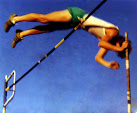
I began this blog for the sole purpose of helping vaulters enjoy and make the most of their pole vaulting days. Pole vaulting can be an expensive and time-intensive sport. Most pole vaulters will not be able to enjoy having a pit in their own backyard and have to practice at school or club facilities. Poles can be expensive. Finding a good coach is not always easy.
As a teenager looking for a sport in which I could excel, I was fortunate to become acquainted with a coach who steered me in the right direction. Not every beginning athlete finds their way easily or quickly. I want to encourage all pole vaulters, offer advice for safe training, share with you my illustrations, and help you pole vault higher and safely - every time.
Formerly, for several years I authored a pole vault website - Pole Vault Higher. With the easier-to-use blog tools, I'm hoping to more efficiently help you become a safer, more efficient pole vaulter.
Showing posts with label pole vault higher. Show all posts
Showing posts with label pole vault higher. Show all posts
Monday, June 23, 2014

Thursday, January 21, 2010
The Swing is a Key Element in Pole Vaulting.
Perfecting the swing-phase of your pole vault is a key element in improving your vault.
In the past, I have worked diligently with beginning vaulters to ensure a correct take off step - because I have found that this one phase done correctly makes the most difference in the overall vault. Done incorrectly the take off can adversely affect the vault and make it impossible to improve.
With that said, I will now talk about the swing mechanics - with the assumption you are taking off correctly with your step directly under your top hand and thinking about running straight forward through the pit. What happens just at the second your pole tip contacts the back of the box is that your body becomes stretched from the top hand to the toes of the take off foot as your front leg and knee are driving forward to pull you into the pit. This long line forms the pendulum that is used to generate the speed of the rock back phase. The instant the stretch of the forward penetration feels complete, the vaulter should make a conscious and exerted effort to swing the trail leg rapidly to the pole in a long line from the top hand. Think of a sling with a rock in it. This swinging action must be deliberately, with practice, and must be performed technically and correctly to be effective.
Watching videos of world class top vaulters - while slowing and stopping the action pauses these miraculous vaults during swing stage and gives a vaulter a visual idea of how the swing looks - in action and performed accurately. You will notice that the top vaulters combine the drive phase and the swing into one continuous motion. These top vaulters are aiming for maximum penetration by running straight through the take off while swinging the longest extension of their body rapidly through the bottom of the vault and to the pole - all generating tremendous power - which propels the reverse action and throws the body upside down without having to pull it back or struggle to get back. The body will be spun backwards with great force as the trail leg is shortened and tucked close to the pole as the swing transitions into the tucking rock back.
Think of an ice skater and how they spread their arms and spin. When they bring their arms tight to the body, the spin speed increases dramatically. This is what we want to see with the pole vault swing - body propulsion.
When the trail leg cranks from the take off step - and at the point the toe of the take off step is pushing off the ground to the point the toe passes the pole, this is the phase in which degrees of swing are generated. You can actually swing harder to accelerate your penetration.
Practice the swing on short runs and pop ups until you start to feel yourself controlling and perfecting the technique.
There are coaches who insist that when the run and plant are done correctly, the swing will take care of itself. I agree in principle and this is true for novice vaulters. Great vaulters will always have control of their swing and use it to ensure their complete reverse action and speed in achieving it.
Sergei Bubka is The Vaulter whose swing phase I would recommend observing. American vaulter Dean Starkey also has a superior swing phase.
Subscribe to:
Posts (Atom)