Coming Soon!
As many of you already know, Jerry has retired from pole vaulting and coaching after over 40 years.
Aside from advocating safer pole vaulting, I have one more goal in this field of track and field: to complete my comprehensive book on pole vaulting.
Anticipated publication of my pole vaulting book is Spring 2015. In planning my comprehensive pole vaulting book, I am compiling my 40-years-worth of pole vault data - including training notes and original illustrations. I hope to create a book for all pole vaulters - which can be accessed through Kindle and Nook, but also be available in paperback.
I feel I have a unique perspective on pole vaulting, as I have participated as an athlete, coach, official, illustrator, writer, and inventor. As an athlete, I was a college All-American. I coached over 20 state pole vaulting champions. I coached Florida's first and only high-school 17-foot-vaulter - Mike Holloway, who went on to the World Championships in 1993, with a best of 19'1". During the 1980s and early 1990s, I had a professional relationship and friendship with Dr. Dick Ganslen, the author of the Mechanics of the Pole Vault books. I illustrated Dr. Ganslen's poster and contributed illustrations and advice for his final book. My association with Ganslen, plus my elite coaching experiences during this time when the world record was being set and the modern techniques were being tested, lend me a special perspective on the key elements of the pole vault.
My experience has given me insight to the key elements necessary to improving pole vault technique. Look for my book to give you encouragement and clearly-explained steps to help you accomplish your pole vault goals.
Watch for news of my pole vault book release on this blog.
Monday, March 25, 2013

Monday, March 11, 2013
Dr. R. V. Ganslen: Mechanics of the Pole Vault.
Dr. Richard (Dick) Ganslen's book - Mechanics of the Pole Vault, ninth and last edition - was released in 1980. Known as "the bible of the sport" - pole vaulting - Mechanics of the Pole Vault books in the series were analytical studies from the perspective of an accredited Doctor of Physics.
In 1979, I collaborated with Ganslen on this ninth edition of Mechanics of the Pole Vault, mailing pole vault illustrations and ideas which Ganslen incorporated in original form as well as reworked art.
As a result of the USA Olympic boycott of 1980, Ganslen sought another commercial venture to publicize the book - this time in the form of a poster, which was sponsored by Cata-Pole pole vault manufacturers. The Ganslen/Cata-Pole venture was a great idea because every pole sold - in the entire world - came packaged with this poster, which I illustrated!
After communication with Sergei Bubka and Bubka's coach Vitaly Petrov, Dr. Ganslen's final contribution to pole vaulting was a second, more renowned poster featuring my illustration. That sequence I drew is described as the most accurate and detailed pole vault sequence illustration to this day... because Ganslen and Petrov exchanged the most up-to-date technical information and photos.
In 1979, I collaborated with Ganslen on this ninth edition of Mechanics of the Pole Vault, mailing pole vault illustrations and ideas which Ganslen incorporated in original form as well as reworked art.
As a result of the USA Olympic boycott of 1980, Ganslen sought another commercial venture to publicize the book - this time in the form of a poster, which was sponsored by Cata-Pole pole vault manufacturers. The Ganslen/Cata-Pole venture was a great idea because every pole sold - in the entire world - came packaged with this poster, which I illustrated!
After communication with Sergei Bubka and Bubka's coach Vitaly Petrov, Dr. Ganslen's final contribution to pole vaulting was a second, more renowned poster featuring my illustration. That sequence I drew is described as the most accurate and detailed pole vault sequence illustration to this day... because Ganslen and Petrov exchanged the most up-to-date technical information and photos.
 |
| 5 of 9 editions of Ganslen's renowned Mechanics of the Pole Vault books. |
 |
| My suggestions and drawings led to this center-of-gravity page in Ganslen's Mechanics of the Pole Vault. |
Tuesday, January 1, 2013
Pole Vault Illustrated Overview and Update.
Be sure to check the Pole Vault Illustrated Archives at right: There are 58 posts to-date, beginning January 1, 2009. One disadvantage of blogs is the viewing-display of posts. Entering a blog, you see the newest post and some recent ones, but to really get a good blog overview - you should really select some of the older and first posts (which are archived in the older posts). You can access the older posts by selecting the years and months within the archives, or by scrolling to the bottom of the page and selecting "older posts".
If you've been following Pole Vault Illustrated, check the archives - as I have recently added more photos and captions to older posts.
Leave comments if you read a post that prompts any pole vaulting questions or discussion. I really enjoy discussing pole vaulting technique, safety advances, and theories.
I am currently amassing my many illustrations and coaching notes to adapt to book form and it should be available in the not-too-distant future.
Here are links to two of my older posts (... you might find them helpful in improving your pole vault technique). The True Secret of Effective Modern Pole Vaulting and The Swing is A Key Element in Pole Vaulting.
If you've been following Pole Vault Illustrated, check the archives - as I have recently added more photos and captions to older posts.
Leave comments if you read a post that prompts any pole vaulting questions or discussion. I really enjoy discussing pole vaulting technique, safety advances, and theories.
I am currently amassing my many illustrations and coaching notes to adapt to book form and it should be available in the not-too-distant future.
Here are links to two of my older posts (... you might find them helpful in improving your pole vault technique). The True Secret of Effective Modern Pole Vaulting and The Swing is A Key Element in Pole Vaulting.
Monday, July 5, 2010

Sunday, July 4, 2010
Pole Vault Beginners: Getting Started.
Hello and welcome to all you pole vaulters out there.
I began this blog to help any of you who are wondering how you can improve your pole vault - and also to help beginners who want to learn safe and effective vaulting techniques. After 40 years of combined vaulting and coaching (with several champions to my credit and records of my own), I believe I am just the person who can help at any level of the event.
I will be submitting numerous illustrations and videos on this blog - to help define the vault in easy to understand steps. Keep checking this blog on a regular basis and ask questions. You will soon be on the fast track to pole vault success.
Leave your comments in the form below this post and I will try my best to answer them.
I began this blog to help any of you who are wondering how you can improve your pole vault - and also to help beginners who want to learn safe and effective vaulting techniques. After 40 years of combined vaulting and coaching (with several champions to my credit and records of my own), I believe I am just the person who can help at any level of the event.
I will be submitting numerous illustrations and videos on this blog - to help define the vault in easy to understand steps. Keep checking this blog on a regular basis and ask questions. You will soon be on the fast track to pole vault success.
Leave your comments in the form below this post and I will try my best to answer them.
Jerry Hock Pole Vault Memorabilia.
 |
| 1969 Orlando, Florida track meet newspaper clipping. |
 |
| Late 1960s high school track team. |
 |
| High School newspaper clipping, Jerry Hock 13-foot 6-inch school pole vault record. |
 |
| 1972 Raider Junior College track team. |
Saturday, July 3, 2010
Friday, June 4, 2010
Jerry Hock Pole Vault Illustrations.
 |
| Jerry Hock illustration of Sergei Bubka - from Dick Ganslen photo. |
Thursday, June 3, 2010
Jerry Hock Mechanics of the Pole Vault Illustrations.
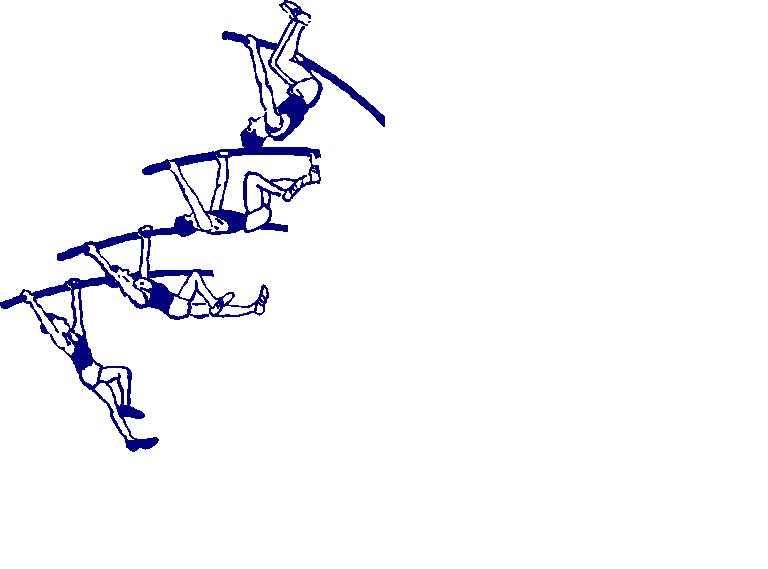 |
| Jerry Hock illustrates Mechanics of the Pole Vault. |

Wednesday, June 2, 2010
USA Track and Field Championships, Houston 1989.
 |
| Jerry Hock, honorary official at USATF championships Houston 1989. Kory Tarpenning 19-feet Houston 1989. |

Pole Vault Inversion-Training Device.
 |
| Jerry Hock Pole Vault Inversion-Simulator Training Device. Leave comment below for further discussion. |
Computer Illustration Showing Pole Vault Front Knee Role.
 |
| Jerry Hock computer illustration depicting the role of the lead-knee in pole vaulting. |
Pole Vault Extension, Photoshopped.
 |
| Photoshopped myself to help visualize an improved extension phase of the pole vault. |
Tuesday, June 1, 2010

Winter Park High School 1970 Pole Vault Sequence Photo.
 |
| Jerry Hock photographed in pole vault sequence, Winter Park high school. 11 feet 6 inches, before the 13'6" record. |
Pole Vault Illustrated: Simple Sequence 2009.
 |
| Jerry Hock 2009 pole vault illustration of vaulting sequence. |


Jerry Hock Pole Vault Sequence Drawing: 1980 Ganslen Poster.
 |
| Jerry Hock original Mechanics of the Pole Vault poster illustrations for Dick Ganslen. |
Jerry Hock USA Masters Pole Vaulter at Emory 1990: 13 Feet 6 Inches.
 |
| Jerry Hock pole vaulting at Emory University, Georgia. |
Pole Vault Rock-back Illustration.
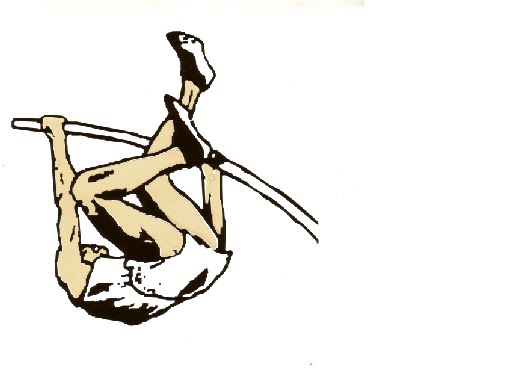 |
| Jerry Hock Rock-back pole vault illustration. Please give credit if you use this illustration. |
Pole Vault Training Illustration: Take-Off-Foot Detail.
 |
| Jerry Hock pole vault illustration detail emphasizing importance of take-off-foot. Leave a comment for discussion. |
Pole Vault Take-Off Illustrations.
 |
| Jerry Hock Pole Vault Take-Off illustration. Please give credit when using Jerry Hock illustrations. |
Jerry Hock Indoors at O'Connell Center, University of Florida 2007.
 |
| Coach and USA Master vaulter Jerry Hock pole vaulting indoors at O'Connell Center, FLA. |

Jerry at Charlie Polhamus Meet 2008.
 |
| Fitzgerald Georgia Pole Vault Invitational, Jerry Hock at Charlie Polhamus Meet. |

With Lacy Jansen and Family.
 |
| Enjoyed a visit with renowned pole vaulter Lacy Jansen. Good pole vault discussion. |
Invention: Bungee Pole Vault Simulator 2010.
 |
| Leave a comment to begin discussion of this bungee pole vault training device. |
Thursday, January 21, 2010
The Swing is a Key Element in Pole Vaulting.
Perfecting the swing-phase of your pole vault is a key element in improving your vault.
In the past, I have worked diligently with beginning vaulters to ensure a correct take off step - because I have found that this one phase done correctly makes the most difference in the overall vault. Done incorrectly the take off can adversely affect the vault and make it impossible to improve.
With that said, I will now talk about the swing mechanics - with the assumption you are taking off correctly with your step directly under your top hand and thinking about running straight forward through the pit. What happens just at the second your pole tip contacts the back of the box is that your body becomes stretched from the top hand to the toes of the take off foot as your front leg and knee are driving forward to pull you into the pit. This long line forms the pendulum that is used to generate the speed of the rock back phase. The instant the stretch of the forward penetration feels complete, the vaulter should make a conscious and exerted effort to swing the trail leg rapidly to the pole in a long line from the top hand. Think of a sling with a rock in it. This swinging action must be deliberately, with practice, and must be performed technically and correctly to be effective.
Watching videos of world class top vaulters - while slowing and stopping the action pauses these miraculous vaults during swing stage and gives a vaulter a visual idea of how the swing looks - in action and performed accurately. You will notice that the top vaulters combine the drive phase and the swing into one continuous motion. These top vaulters are aiming for maximum penetration by running straight through the take off while swinging the longest extension of their body rapidly through the bottom of the vault and to the pole - all generating tremendous power - which propels the reverse action and throws the body upside down without having to pull it back or struggle to get back. The body will be spun backwards with great force as the trail leg is shortened and tucked close to the pole as the swing transitions into the tucking rock back.
Think of an ice skater and how they spread their arms and spin. When they bring their arms tight to the body, the spin speed increases dramatically. This is what we want to see with the pole vault swing - body propulsion.
When the trail leg cranks from the take off step - and at the point the toe of the take off step is pushing off the ground to the point the toe passes the pole, this is the phase in which degrees of swing are generated. You can actually swing harder to accelerate your penetration.
Practice the swing on short runs and pop ups until you start to feel yourself controlling and perfecting the technique.
There are coaches who insist that when the run and plant are done correctly, the swing will take care of itself. I agree in principle and this is true for novice vaulters. Great vaulters will always have control of their swing and use it to ensure their complete reverse action and speed in achieving it.
Sergei Bubka is The Vaulter whose swing phase I would recommend observing. American vaulter Dean Starkey also has a superior swing phase.
In the past, I have worked diligently with beginning vaulters to ensure a correct take off step - because I have found that this one phase done correctly makes the most difference in the overall vault. Done incorrectly the take off can adversely affect the vault and make it impossible to improve.
With that said, I will now talk about the swing mechanics - with the assumption you are taking off correctly with your step directly under your top hand and thinking about running straight forward through the pit. What happens just at the second your pole tip contacts the back of the box is that your body becomes stretched from the top hand to the toes of the take off foot as your front leg and knee are driving forward to pull you into the pit. This long line forms the pendulum that is used to generate the speed of the rock back phase. The instant the stretch of the forward penetration feels complete, the vaulter should make a conscious and exerted effort to swing the trail leg rapidly to the pole in a long line from the top hand. Think of a sling with a rock in it. This swinging action must be deliberately, with practice, and must be performed technically and correctly to be effective.
Watching videos of world class top vaulters - while slowing and stopping the action pauses these miraculous vaults during swing stage and gives a vaulter a visual idea of how the swing looks - in action and performed accurately. You will notice that the top vaulters combine the drive phase and the swing into one continuous motion. These top vaulters are aiming for maximum penetration by running straight through the take off while swinging the longest extension of their body rapidly through the bottom of the vault and to the pole - all generating tremendous power - which propels the reverse action and throws the body upside down without having to pull it back or struggle to get back. The body will be spun backwards with great force as the trail leg is shortened and tucked close to the pole as the swing transitions into the tucking rock back.
Think of an ice skater and how they spread their arms and spin. When they bring their arms tight to the body, the spin speed increases dramatically. This is what we want to see with the pole vault swing - body propulsion.
When the trail leg cranks from the take off step - and at the point the toe of the take off step is pushing off the ground to the point the toe passes the pole, this is the phase in which degrees of swing are generated. You can actually swing harder to accelerate your penetration.
Practice the swing on short runs and pop ups until you start to feel yourself controlling and perfecting the technique.
There are coaches who insist that when the run and plant are done correctly, the swing will take care of itself. I agree in principle and this is true for novice vaulters. Great vaulters will always have control of their swing and use it to ensure their complete reverse action and speed in achieving it.
Sergei Bubka is The Vaulter whose swing phase I would recommend observing. American vaulter Dean Starkey also has a superior swing phase.
Saturday, February 21, 2009
The True Secret of Effective Modern Pole Vaulting.
This may be the most profound post I have ever entered.
After 40 years as a pole vaulter and coach, I discovered something so meaningful - this summer - my theories of pole vault technique (as well as my approach to pole vault coaching) have completely evolved.
The points I will elaborate in this post will seem to some - merely common sense. Others will read this and think, "I do this already." If this is the case, then I congratulate you - because you must either be a natural athlete or a well-coached one. My own profound realization came as part of an inability to vault vertically as a masters vaulter. During the past 6 years of masters vaulting (age 52 -58), I had only achieved the mediocre height of 11-feet 6-inches. My effective grip was almost 12-feet, so I was flagging (not getting my legs up) for nearly 6 years.
After a 2 year hiatus I decided to try one more time to remedy my inability to vault vertically. As a coach for years and years I knew exactly what I was doing wrong and tried hundreds of techniques and keys to remedy this flagging vault. I tried swinging harder, I tried getting my feet back to the pole, I tried tucking, I tried utilizing a strong take-off knee - none curing my basic problem. Keep in mind this secret which I am about to reveal to you will only make a big difference in your vault if you are already proficient in the basic techniques of the vault.
For this secret vaulting-remedy to work, it is mandatory for you to have already mastered a good run and correct step.
My realization of this secret occurred one day this past August when I decided to think about my hands and their role in the vault. I even told my wife (who was filming one of my first attempts with the hand-focus) that I was going to try a hand-oriented jump. What I soon realized and am now revealing to you is the simple truth about how important your hands are to your vault.
If you just take a minute to think about it - visualize - you will see that the only contact you have with the pole vault pole is your hands.
What your hands do to manipulate your body both before the take-off and throughout the vault is crucial to your success.
In my case, I realized my hands have always been very passive during vaults. I have always had a better than average run and have the ability to hold the pole high relative to my age. My step has always been almost perfect for 40 years and although I don't have a very good drive knee I have a pretty good swing and I do get my hips up and back during the vault.
What I discovered about my hands was that I was just basically "holding on". As I was running hard toward the take-off, I thought about making a nice high plant. As the pole contacted the box I would even be sure to drive forward - and at times I was able to get my front knee up which made the transition to my rock back easier.
What I have not paid attention to or practiced during my career is the PRO-ACTIVE use of my hands. This use of the hands must be anticipatory and focused. Even before your pole strikes the plant box, you must anticipate the jolt to your hands. It is not enough for a vaulter to just hold onto the pole and be swept-up in the bottom of the vault. It is advisable to take control of the pole with both hands from the instant of impact.
Recognizing the hands as the ultimate controlling factor in the vault, I began to have the ability to manipulate my body into the desired technical positions. I had a light-bulb-moment as I realized I had been reacting to the position I was in (following my take-off and swing) and not actually controlling my own destiny from the second of impact.
I started noticing many other vaulters who were making the same mistake I had been making my entire career. My own vault started to improve dramatically. I started watching my old videos of Sergei Bubka ,Tim Mack , Jeff Hartwig, Joe Dial and masters great Gary Hunter. I watched how they used their hands pro-actively throughout their vaults and what a difference it made in their results. I was able to use my front hand much more effectively at the take-off and in doing so I was able to sharpen my focus - and even hyper-focus at the second of impact.
Focusing on the role of the hands and the grip allowed me to stay ahead of the vault in my mind and not chase the pole as I had been doing for 40 years.
For once I was not reacting to my orientation in the vault after the inevitable blur of the physical pounding and stretching that occurs at the moment of impact and the fractions of seconds afterwards.
I discovered I could control my body from this moment and that this early control was key in the chain and sequence that follow in the pole vault. In my case I was able to tune-into my body and correct it's flagging flight. I started almost immediately to improve the top of my vault and to vault more vertically. My friends and co-vaulters have been commenting on the improvement in my vaults, particularly saying how much more vertical my vaults have become.
The secret to a vertical vault may be in your hands. Anticipate, focus and be pro-active with your hands and you will see significant improvement in your vault.
After 40 years as a pole vaulter and coach, I discovered something so meaningful - this summer - my theories of pole vault technique (as well as my approach to pole vault coaching) have completely evolved.
The points I will elaborate in this post will seem to some - merely common sense. Others will read this and think, "I do this already." If this is the case, then I congratulate you - because you must either be a natural athlete or a well-coached one. My own profound realization came as part of an inability to vault vertically as a masters vaulter. During the past 6 years of masters vaulting (age 52 -58), I had only achieved the mediocre height of 11-feet 6-inches. My effective grip was almost 12-feet, so I was flagging (not getting my legs up) for nearly 6 years.
After a 2 year hiatus I decided to try one more time to remedy my inability to vault vertically. As a coach for years and years I knew exactly what I was doing wrong and tried hundreds of techniques and keys to remedy this flagging vault. I tried swinging harder, I tried getting my feet back to the pole, I tried tucking, I tried utilizing a strong take-off knee - none curing my basic problem. Keep in mind this secret which I am about to reveal to you will only make a big difference in your vault if you are already proficient in the basic techniques of the vault.
For this secret vaulting-remedy to work, it is mandatory for you to have already mastered a good run and correct step.
My realization of this secret occurred one day this past August when I decided to think about my hands and their role in the vault. I even told my wife (who was filming one of my first attempts with the hand-focus) that I was going to try a hand-oriented jump. What I soon realized and am now revealing to you is the simple truth about how important your hands are to your vault.
If you just take a minute to think about it - visualize - you will see that the only contact you have with the pole vault pole is your hands.
What your hands do to manipulate your body both before the take-off and throughout the vault is crucial to your success.
In my case, I realized my hands have always been very passive during vaults. I have always had a better than average run and have the ability to hold the pole high relative to my age. My step has always been almost perfect for 40 years and although I don't have a very good drive knee I have a pretty good swing and I do get my hips up and back during the vault.
What I discovered about my hands was that I was just basically "holding on". As I was running hard toward the take-off, I thought about making a nice high plant. As the pole contacted the box I would even be sure to drive forward - and at times I was able to get my front knee up which made the transition to my rock back easier.
What I have not paid attention to or practiced during my career is the PRO-ACTIVE use of my hands. This use of the hands must be anticipatory and focused. Even before your pole strikes the plant box, you must anticipate the jolt to your hands. It is not enough for a vaulter to just hold onto the pole and be swept-up in the bottom of the vault. It is advisable to take control of the pole with both hands from the instant of impact.
Recognizing the hands as the ultimate controlling factor in the vault, I began to have the ability to manipulate my body into the desired technical positions. I had a light-bulb-moment as I realized I had been reacting to the position I was in (following my take-off and swing) and not actually controlling my own destiny from the second of impact.
I started noticing many other vaulters who were making the same mistake I had been making my entire career. My own vault started to improve dramatically. I started watching my old videos of Sergei Bubka ,Tim Mack , Jeff Hartwig, Joe Dial and masters great Gary Hunter. I watched how they used their hands pro-actively throughout their vaults and what a difference it made in their results. I was able to use my front hand much more effectively at the take-off and in doing so I was able to sharpen my focus - and even hyper-focus at the second of impact.
Focusing on the role of the hands and the grip allowed me to stay ahead of the vault in my mind and not chase the pole as I had been doing for 40 years.
For once I was not reacting to my orientation in the vault after the inevitable blur of the physical pounding and stretching that occurs at the moment of impact and the fractions of seconds afterwards.
I discovered I could control my body from this moment and that this early control was key in the chain and sequence that follow in the pole vault. In my case I was able to tune-into my body and correct it's flagging flight. I started almost immediately to improve the top of my vault and to vault more vertically. My friends and co-vaulters have been commenting on the improvement in my vaults, particularly saying how much more vertical my vaults have become.
The secret to a vertical vault may be in your hands. Anticipate, focus and be pro-active with your hands and you will see significant improvement in your vault.
Subscribe to:
Posts (Atom)